Showing posts with label Model 16H. Show all posts

Sunday, July 10, 2011

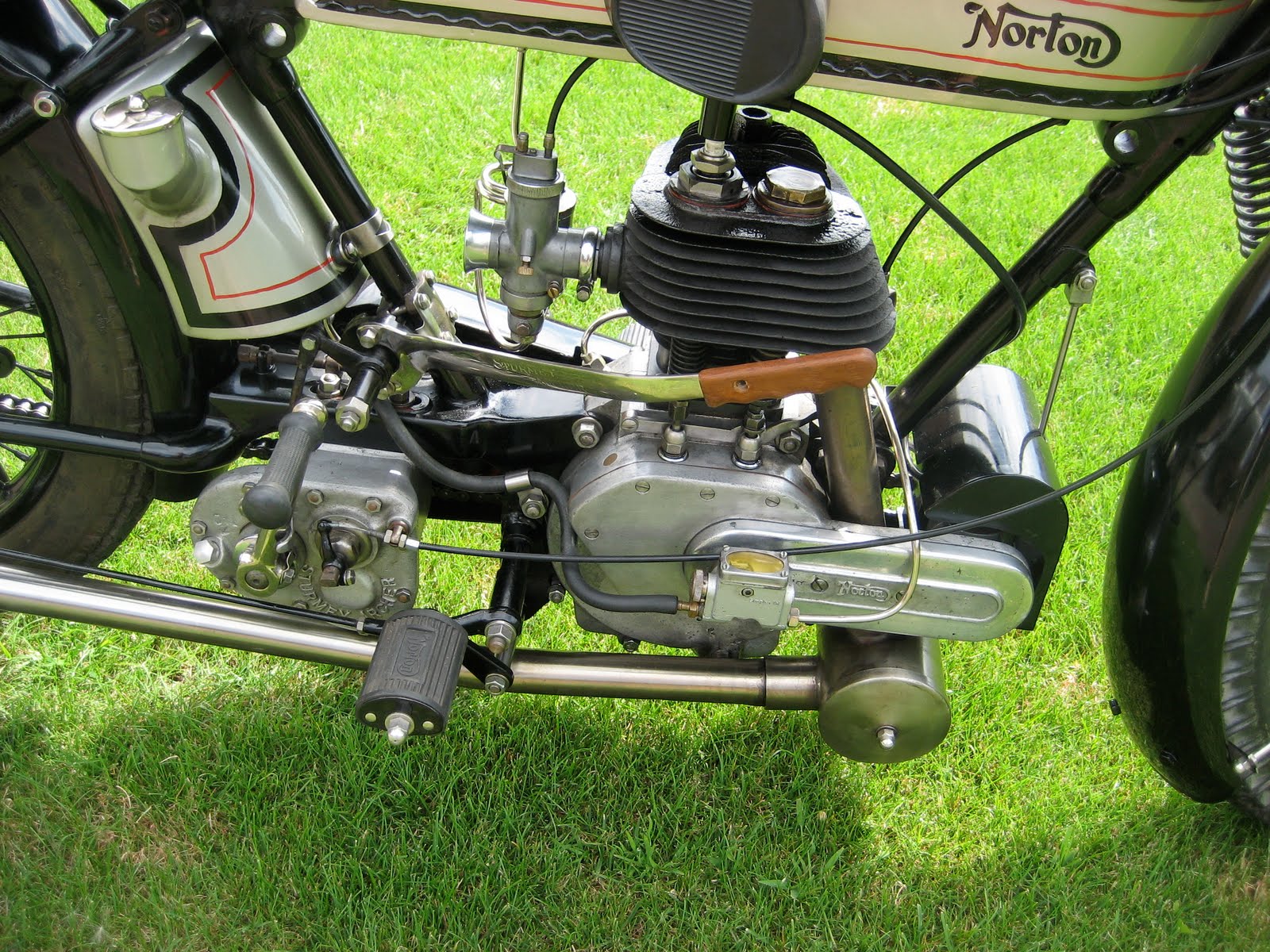
1927 16H Norton


The 1927 Norton 16H. Nice bike but no match for the 1928 M18 that followed so she had to go. Well, we're not owners anyway, just keepers, looking after them for a while before they move on. More on Paul's blog.

Tuesday, June 14, 2011

Geoff's 1928 Model 16H Norton

Sent by Geoff in the UK


Geoff: "Above two pics of my 1928 16H when I bought it in 2006. As you can see it was an oily rag. I only let it go in 2007 because I wanted the Zenith Super Eight a friend was selling and he wouldn't let me have the Zenith unless I swapped the Norton in exchange! For some reason the carb was removed. It now has the correct cylinder as it came with a later barrel and separate head. The friend I sold it to has restored it to his liking (below). I have recently bought it back!


It came from the Isle of Man and the reg no MN 1150 has now been taken off as an Isle of Man number cannot be used in the UK. In the UK we can keep and transfer registration numbers so as I had the number TT 1358 (which I took from a Mini car I had one time) I have put it on the 16H. I have an original 7" Horton front wheel I am going to fit. It has a post war carb and I have a spare B&B carb. that should be OK"

Saturday, June 4, 2011

1923 Model 16H Norton

Sent by David in the UK


David: "I have recently unearthed this Norton 16H. It has been in a shed for the last 30 years and I think it is quite interesting as it has a separate oil tank and a mousetrap carburettor. I have been told it was raced by a Mr Jack Underwood. The bike will be kept in this condition and not restored."


Simon: "The numbers (frame number 65XX and engine number 42XX) match up - albeit the frame number is shown in the Works records as 65XXs. However the info in the records is disappointingly sparse. The model is shown as 16H and the magneto number as 122914, with Brown and Barlow carburetter and 26 x 2 1/2 tyres.  No gearbox number given. On the despatch details page, all that is entered is the 'card number' (I guess this is the works job card or build card for the bike) 3743. At this stage, this situation seems to have been commonplace - on this particular page (the first that exists incidentally) of 19 entries only 10 show the dealers to whom the bikes were sent and no end user details are shown atall. Despatch dates shown for the ten are all in the range November '22 to January '23. All were 16Hs. 


Regarding the 16H, it does look 'later'. I guess yes a 1923 model originally. I think the separate oil tank was fitted to the '23 works bikes and doubtless could be ordered if wanted but perhaps was a later fitment. The tank looks wide for this date. Also note the forks are the posh variety of Druids with the dampers - not fitted as standard. Fitting a mousetrap Binks was the twenties equivalent of the 'go faster' stick-on stripes for cars in the fifties/sixties. But bear in mind that the early twenties 16H could be made to go. Driscoll reckoned his ex works 16H was better by far than the first OHV bike he got! The oil pump is a later fitment too - furthermore it is a Pilgrim and not a Best and Lloyd. 


I don't know of any Jack Underwood though there are a couple of J. Underwoods who were VMCC members in the 1988 VMCC members list - one living in Blandford and the other in Crawley. One of them (the Blandford one) was a member in 1973 but neither in 1960....Judging by the Blandford Underwood's membership number he must have joined the club in the late sixties.  None of this is really much help!"


Martin:"The registration is a Gloucester County Council one issued in 1929, so whatever it did between 1923 and 1929, it did so with another identity.  By 1929, a 16H would have been passe, but as I know from running a 1920 16H, they have a lot more spirit than many early OHVs, and it would still have been a capable performer in 1929."

Thursday, March 17, 2011

121 MPH Model 16H racer

By Nigel Fox

I run a unique Model 16H Norton racer; it’s based on a very special side valve barrel provided by VMCC founder Titch Allen who got it from Ivan Wicksteed; a summary is in the cutting below. The machine has reached a top speed of 121 miles per hour which is faster that the speeds obtained by famous tuners of side valve engines in the 1920s.


General comments (mostly subjective!)

With an OHV engine the required flow past the inlet valve is needed INLINE with the stem. With a SV engine the required flow past the inlet valve is needed at RIGHT ANGLES to the stem. The special used Wicksteed Barrel mentioned has just two changes in direction of inlet flow, a typical SV engine has three and arguably four! SV barrels distort the piston rings are best pegged to let the rings bed in to the shape. A lot of piston squish makes for a cool running engine. I did run an engine with 100% squish over the piston with “pop up pistons (0.5“) ala some USA performance side valve car motors albeit with normal type inlet ports with reasonable results but the inlet flow over and into the barrel can be restrictive. The race version of a good side valve engine will have a lower compression ratio than a good road version. I suspect low CR engines react better (as an improvement on power) to tuned Inlet and Exhaust lengths than higher CR engines (the cylinder pressure at inlet valve closing is lower). The Norton pre war barrel makes a better high performance engine with more space around the inlet valve. I built an engine with a pre war top on a post war bottom (with standard inlet port position) and this was nearly as quick as the Wicksteed motor. This engine was run on 10% water/methanol fuel as it had just a two-piece flat top plate aluminium head. It had a very light flat top OHV piston (lightening an already very light piston plus an HE30TF small end bush) and this blew up eventually - it was so smooth. The rev limit with the SV Norton engine is not the full compliment roller big end (as Titch suspected) but the 8” con rod (the area below the small end). Titch working with his son Roger on the OHV with a stronger and shorter 7-1/2”con rod found the big end bearing was the limit. I road raced a post war Big 4 and the more metal I removed from the head around the Inlet valve the faster it went, the limit was the stud holes, it had a severe undercut around the valve to leave a gasket sealing face. Head sealing with methanol and petrol: I use a half dried out thin coat of Hammerite aluminium paint! Titch is well remembered for recommending a touch of paraffin to modern fuel with the old low CR engines. Prompted by this I carried out some tests with paraffin on a SV road bike. Titches theory (by my understanding) on this regarding old engines and the low octane petrol that was available and used with them is as follows: old engines pitched their compression ratios just below the detonating CR of the low octane fuel available, but put a higher octane in the same engine and the fuel air mixture so lowly compressed is nowhere near the optimum temperature: it’s going to burn slowly and create all sorts of problems. My road paraffin tests were very interesting - I went up to 25 %

Titch enjoys a cuppa...
Lazarus’ engine specifications

Basis a pre-war rocker follower type engine. 82x100 (528cc). Special Wicksteed modified upswept inlet port barrel. (Titch seemed to think this work was carried out by Granville Grenfell at Brooklands). Special alloy head with modified chamber shape (Titch seemed to think this was made by Roland Cross). Inlet length 13” overall. Exhaust valve std 1.61” G2 (Austenitic). Inlet valve 1.75” (magnetic) modified diesel lorry valve. 2mm head clearance over Inlet valve at full lift. 6.5mm head clearance over Exhaust valve at full lift. Std cast iron valve guides. Valve clearances Inlet 0.004”, Exhaust 0.012”. Moto Guzzi LeMans valve springs (inner and outer). Both valves 103lbf load seated , 157lbf load at 0.375”lift. Insulating washer under exhaust. CR 6.67:1 , 50% squish over piston - 1.7mm clearance. Norton domed solid skirt piston, skirt shortened, (not 16H!). No top ring - slot filled with alloy ring and peened over, 2nd ring pegged two stroke fashion , standard oil ring. Std 8” En24 conrod , polished and shot peened, std big end. Flywheels turned down and ½” steel ring shrunk on. Flat bottomed tappets (Titch seemed to think these may have been an option for the OHV engine). Special Cams Inlet and Exhaust modified by myself for more and gentler lift from std Exhaust cams. Timings at 0.030” lift. Exhaust opens 71deg closes 45deg (total lift 0.334”lift). Inlet opens 57deg closes 60deg (total lift 0.375”lift) (These cam timings are very close to the KTT Mark VI cams). 40” total exhaust length - plain pipe.

1-1/16th Amal TT carburetter bored out to 31.5mm, rubber mounted. 0.118” needle jet, 2.5mm dia, main jet (820). Modified needle (more taper at tip to suit a large jet). Float level adjusted to give a drip at carburettor. Fuel 100% methanol + dash R40. R40 engine oil.

Ignition timing 40deg adv., NGK B8EV spark plug.

Gearing 21,42,24,43 teeth. 5,500rpm giving 114.1mph in top and 103.7mph in 3rd. Gearbox ratios 1,1.1,1.61,2.33 (a mix of gears from International and trials (?) available).

Bantam forks and wheel (19” ) Tyre pressure 30,34 psi. Fairing modified Sprint Super Nero replica (supplied by Titch).


Sculthorpe 29th September 1996

Times and speeds recorded

Standing Kilometer
Run 1 30.25sec - terminal speed 113.2mph
Run 2 28.13sec - terminal speed 111mph
Run 3 28.47sec - terminal speed 112mph

Flying ¼ mile timed after the above standing kilometer run ups
Run 1 No time recorded
Run 2 7.80sec - average speed 115.38mph
Run 3 7.71sec - average speed 116.73mph

Standing ¼ mile with fairing - 15.3sec - terminal speed 92mph

Comment on Run 3: Titch commissioned a friend to do some calculations on Run 3, and as the bike entered the timing lights at 112mph the calculations indicated the machine must have reached at least 121mph to have averaged 116.73 mph over the quarter mile.

Best standing ¼ mile to date:
Wroughton 17th Aug 2008
14.727sec - terminal 90.171mph

No fairing Gearbox ratios 1,1.21,1.614,2.33, Sprockets 21,42,19,43, 1200jet, on 25% nitro, ignition on 45 deg adv., Inlet 13“ overall, Exhaust 46” overall, no megaphone.


Doug Hele and Joe Craig

(Not about side valve tuning but very interesting nevertheless...)

I worked at Norton (Shenstone) in the 1980s as a draughtsman and later a designer under David Garside and Doug Hele. Doug told me he designed and drew up the laydown Norton gearbox mechanism (I did not know this at the time - a very nice piece of work!). Doug just post war was working on the best flywheel balance factor for the Big4 and a young tester got killed on the test bike somehow and Doug received threats from the poor chaps family - to his life! While there in the 1980s Doug was doing tests with angled (back cut) face dogs on the Norton Wankel gearbox gears to aid selection, a young chap on the test bike crashed mysteriously on a road into Walsall, poor Doug perhaps haunted by the earlier events with the Big4 abandoned the angled dogs project there and then. This is only my interpretation - but he did relate the Big4 incident to me at the time of the crash.

Doug also in conversation about past times also mentioned the Desmo Manx work but he did not seem that enamoured or over excited with the project, Cross rotary valve head - oil everywhere, and also a curious twin carb Manx engine sent over from Australia with much promise, that on test developed no more power than a standard Manx, I said maybe the carburettors were meant to be opened progressively to improve power spread, he gave me the same look; well similar to when I questioned the relatively small size of the carbs fitted to the Manx compared to the G50, Gold Star and racing Italian engines; I was relatively a young man and he was a real gentleman; I only ever heard him raise his voice once!

Doug also recalled to me that when in the 1950s working under Joe Craig he was given a design job for a new wheel spindle, Joe supplied a Velocette sample for Doug to copy, Doug went away and did his calculations and drew up what he thought was a better spindle design and showed it to Joe, his reaction was very abrupt “No just make it like the Velocette !”. Maybe poor Joe too was haunted by the past for Jimmy Guthrie riding was killed while riding a works Norton in 1937; there were also rumours of his crash being caused by the rear wheel spindle breaking.

Tuesday, December 21, 2010

1931 Model 16H Norton


Not the most exciting Norton ever made but an interesting model anyway. This is a 1931 Model 16H, still with the  Enfield rear hub and Horton front hub. The first year to have the magdyno situated behind the barrel, dry sump lubrication, Sturmey Archer three speed gearbox. In quite original condition (apart from perhaps the front forks that may be from a later model) and for sale at Dutch Lion Motorbikes.

Thursday, November 25, 2010

Side valve racer


Not a very original bike but in view of the recent post about side valve tuning it would be intesting to find out how fast this one goes.

Sunday, November 14, 2010

1924 Model 16H Norton

Sent by Kevin


Please find attached a picture of a 1924 16H on the 2009 Vintage Irish Rally.

Thursday, November 4, 2010

J T A Temple on his c1922 16H Norton


Temple at the Public Schools Meeting at Brooklands on 14 April 1923, winner of the 500cc One Lap Scratch Race at 71.15 mph and best 500c time in the 500 Metres Sprint (The Vintage Years at Brookland, dr Bayley). He must have been a tall guy.

Simon: ".....sadly I think he came a cropper in the IOM some time later in the twenties. Not shown as a competitor in either the TT or Amateur so it may have been a practise crash....."

Wednesday, October 13, 2010

Luggage racks

An email from Geoff


I obtained an old and original rack for my 1925 Big Four...trouble is it doesnt fit! I think it is from a 16H but I don't know what year bike the rack came off. The arms on this rack are too close together and too short where they bolt onto the frame for my Big Four so I reckon on the Big Four rack the arms are slightly longer and angle slightly outwards at about 15 to 20 degrees so as to fit onto the studs on the outside of the rear downtubes which must be wider apart on the Big Four than the 16H. Another reason it doesnt fit could be that pre-1925 model racks have a different part number to 1925 onward models. If anyone can send me the dimensions of a 1925 to 1927 Big Four rack from the fixing bolt holes just above the spindle vertically to the topside of the platform where the luggage fixes and the length of the front arms I would be very grateful!

Monday, October 11, 2010

Mark's 1923 Model 16H Norton

An email from Mark


I am in  Cape Town South Africa and have a 1923 16H (above) and I am in need of a piston and if possible a barrel as well. Mine came with a bad score inside from the gudgeon pin and has an incorrect piston that somebody has machined the shoulder almost completely off; it does not appear to ever have run with this piston. Who has a spare barrel and piston available? The gudgeon pin is ¾” ( 18.87mm).

Simon: "My piston data shows that the gudgeon pin was 5/8" not 3/4" and the piston was cast iron, as one would expect. The Hepolite number for it is shown as 269 or, in aluminium (slightly later but still 5/8" pin) number 1509".

Sunday, September 12, 2010

For sale: 1929 Norton Model 16H

This tidy looking 1929 16H is for sale at eBay. It appears to be quite original except for few minor issues: wrong carburetter, no front stand, front brake arm plated (like many others!), later knee grips, wrong magneto and cover, wrong silencer and clutch cover on the primary chain guard. Tank gear change makes one think of 1930 but a few late '29 models may have had this on them. The saddle springs look enormous!

Sunday, August 22, 2010

Elsie and Mairi go to War

By Martin Shelley


I thought you might be interested to hear about a show in the Edinburgh Festival I have been involved with using the faithful 1920 16H Norton. Before the show opened, I took the author round Edinburgh to do some promotion of the show, (photo above, spoiled only by Di Atkinson's bright red sneakers, which should have been photoshopped to a dark brown to disguise them!!) and she then asked if she could use it in the actual show as a prop. This involved emptying the tank and giving the bike a thorough clean, which was actually quite a chore but has been beneficial otherwise as the bike hasn't had a 'proper' clean for a long time!

The show was called 'Elsie and Mairi go to War', a stirring true tale about two WW1 motorcyclists who had an amazing time nursing right on the western front near Ypres and who survived to tell the tale unlike many who perished... Take a look by following this link. Although the girls didn't actually ride Nortons, they were delighted to have the bike for the show, and it performed admirably as a static exhibit onstage, occasionally with one or other or both of them acting out a story in animated fashion. I had strapped the rear stand down so the bike couldn't roll off with disasterous consequences. After the last show, I refilled the tank and she started first kick and I rode her home!! What a performance!!

Remarkably, the My Royal Enfields blog has a post on this same subject today!

Wednesday, August 11, 2010

Bert's c1927 Model 16H Norton


Bert bought his wife a 16H. It's a circa 1927 model that has been in a Danish museum for years.

Monday, August 9, 2010

1924 Model 16H Norton oilpump

By Simon


Regarding the 1925 16H from Kingston upon Hull, is that an oil pump driven from the exhaust cam - and is this (see photo) another of the same? This Norton is in a private collection in New Zealand, unrestored, very original and a year older. Perhaps someone recognises the oil pump type - which I don't!

Note added: refer to this blog entry for info on the oil pump used.

Wednesday, August 4, 2010

Malcolm's 1925 Model 16H Norton


An email from Bruce in the US:

"I have attached a photo of my grandfather, Malcolm Freeborough, on his Norton. The back of the picture is inscribed with his name and the comment "mid 1920's". I believe Malcolm was born, and lived in Kingston-upon-Hull at the time the photo was taken, perhaps by his future wife (they were married in 1929). By early 1930s Malcolm was living in Belgium as a Works Manager for his firm. I am hoping that by identifying the bike and the license plate number I can date the picture a little more accurately. The bike probably ended up in Belgium. Malcolm stopped riding after waking up on the side of the road one evening on his way home from work. He commented to me that with a wife and child, he felt he ought to consider less risky transportation. Kind regards, Bruce Glanville."


The registration plate would have been issued by the Kingston-upon-Hull County Borough Council somewhere between January 1925 and January 1930. The Norton is a 1925 Model 16H with a full set of electric lights; note the switch below the saddle. There is a Cowey horn mounted on the top frame rails. Refer to this blog entry for the oilpump type.

Tuesday, July 13, 2010

Hollowell on his 1921 Model 16H Norton


This is Billy Hollowell at the 1921 Isle of Man Senior TT in which he finished 12th. The motorcycle is a model 16H I guess. Billy lost his life in the 1925 Belgian GP in 1925.