Showing posts with label 1926. Show all posts

Wednesday, June 22, 2011

Woods' winner ON7170

By Simon


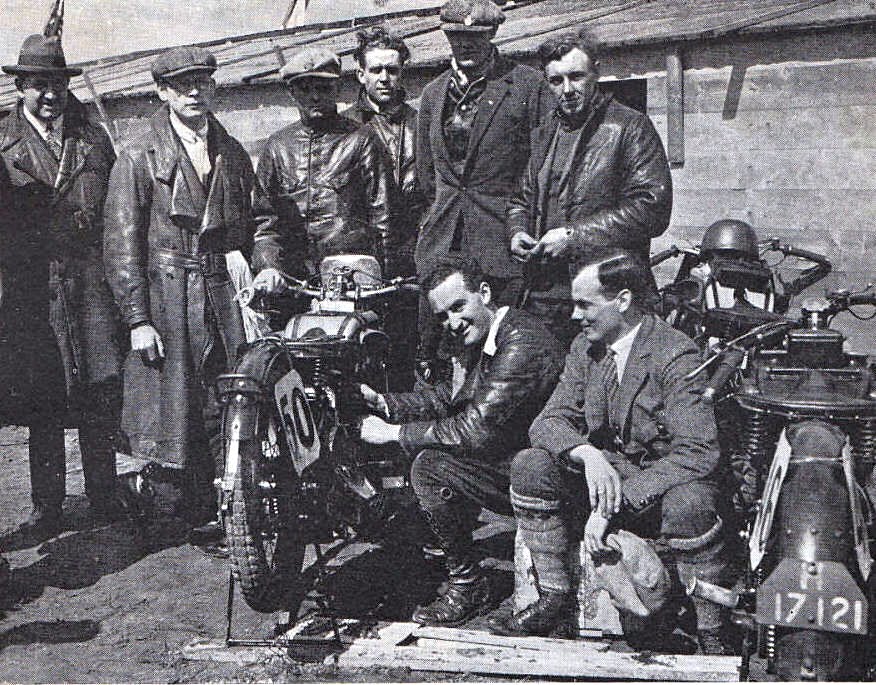
In 1926 Stanley Woods rode for Nortons for the first time and his mount for the Senior TT was a dry sump OHV machine fitted with pannier tanks.  As mentioned in the earlier blog, this was a development of the 1925 TT bikes, with various changes to both the engine and the cycle parts.  Stanley has recounted how well the bike went in practise – until a conrod breakage wrecked the engine.  A replacement engine was fitted, which however vibrated badly, and further work was done on it which obviously sorted the problem in that SW came home the winner at 67.54mph.  The bike had registration number ON7170 and here are a couple of photos – one a paddock shot (above) and one – well known (below) – showing a jubilant Stanley at the finish on, one assumes, the same bike.


It is not, as far as I know, recorded exactly when or how but this particular machine became Stanley’s property.  It may have been given to him by a grateful management or he may have bought it. Whatever, it seems he loaned it to fellow Irishman  B G D’Olier for some events in 1927.  B G D’Olier, I have been told, lived and farmed in South Africa but returned to his homeland from time to time. On a recent visit to Dublin I noticed a large 19th century block in the city centre called D’Olier Building from which I assume his family was reasonably well off.  Be that as it may, he must have been friendly with Stanley to be loaned his Norton. However, in 1928 Stanley sold ON7170 to leading Yorkshire clubman Bill Milner. Stanley had become friendly with the Milner family and in his early days at Nortons (he was issued with a sidecar outfit and travelled the country as a sales rep.) stayed with them at regular intervals.

How did I become interested in these events?  Some fifty years back, I bought a pannier tanked flat-tank OHV Norton - albeit with a standard, not dry sump, engine. This had registration number OX1619 and I set about trying to find out about it. I spoke to Geoff Davison, former Lightweight TT winner and by then publisher of the TT Special and member of the Vintage Club. Geoff said he knew nothing about it but suggested I contacted Bill Milner as he felt sure Bill had owned the ex-Woods bike at some stage. A letter to Bill brought forth a prompt reply (below) along with a subsequent screed.  Note the name of Bill’s house – Norton Woods!  Bill rode the bike in the ’28 Amateur (he retired with rocker problems after other mechanical problems in practise) and his comments are interesting even though he is not quite right in saying no pannier tanked bikes were sold.  As he recounts, he sold most of the bike to Ernie Jackson of York, with, he told me in a subsequent conversation, the frame going to Ernie too but at a later date. Ernie was an inveterate builder of specials and it seems from subsequent articles about him that the original frame MAY have been modified to have rear springing on it.  The net result seems to have been that a machine containing the TT engine from ON7170 became one of several Jackson Specials.


Then the trail goes cold until a small advert appeared in the VMCC magazine in February1968.  It read: “1926 Norton Model 18. This machine is rough, dismantled, incomplete and has been fitted with rear springing but is undoubtedly a Works TT machine reputed to be Stanley Woods’ winner.  Special dry sump motor, large pannier tanks, special frame. Some spares including 1927 TT Replica engine.” And the price for this desirable package ... eat your hearts out, chaps ... £20.00 or near offer!

Who actually bought it, I am not wholly sure but move on to 1980 and an ad. appeared in Motor Cycle Sport reading: “1926/8 OHV Norton. Authenticated 1926 TT winner’s log book. “ I forget the price but in any event, at the time, I was involved in a new job and a new house and felt I had to be content with what Nortons I already had, to say nothing of my ex Brooklands Flying Eight Coventry Eagle. So, after a short interval I rang the advertiser, a Mr C W G Chandler, for a chat about his – by then ex – bike.  He told me that it was not a flat tanker but was a 1929-ish frame with a 1926 Dry Sump TT engine fitted – first registered in 1936 as the Jackson Special AVY 64 -  and that when he bought it, it was entirely dismantled and included a pair of pannier tanks, which he had sold separately.  He had assembled a bike from what was there and as a result it had a later ‘top half’ and Norton forks/front wheel.


After a couple more owners, the Jackson Special in this form (above) finished up with a good friend – sadly he died a few years back – and is still owned by his family. What became of the original frame is anyone’s guess.

A final word on this convoluted tale – the despatch books list the 1926 TT machines and against one of them – in faint pencil – is written ‘on loan S Woods’.  Was this ON7170? Quite likely.  However the engine now in the Jackson Special has number 30589 – not the number of the ‘on loan’ bike. And although this number appears in the list there are no details shown against it of any sort. Whether it was a number allocated to one of the spare TT engines, fitted to ON7170 after the original practise blow-up, can only be assumed. It is all too easy to draw conclusions from unsupported snippets of information (a trap many authors of motor cycle related books  and articles fall into ) but all I can confirm with certainty is that the bottom end of  30589 shows the main sign of being a TT  engine in that it has 1” mainshafts as opposed to the smaller 22mm shafts fitted to all of the rest of the range at the time (including, when they became available, the Model 25s).....

Postscript: Our eagle eyed contributor Roger has suggested that the Keig paddock photo of Stanley on the bike with reg. number ON7170 may NOT actually be the bike on which he won the '26 Senior. He points out that the steering damper knob is mounted a different way up and also that the handlebar grips differ (albeit the photos are taken from opposite sides).  He also considers that the magneto stay support lug on the front down tube is in a slightly different place on the two machines shown.  He may be right about their identities even though it does not really seem to alter what Bill Milner has related.  At this point in time, it's difficult to be 100% sure.

Monday, June 13, 2011

Stanley on the 1926 senior TT winning Norton

By Simon


The recent ITV4 programme covering Formula One commentator Murray Walker's reminiscences provided tantalising viewing of a few seconds' duration of the admirable Stanley Woods on his 1926 TT winner.  It would be good to see more - if it exists.  The twin of his bike was pictured earlier on the blog, a pannier tanked dry sump OHV machine with registration number ON6793.  Until recently, I had never seen an actual, as opposed to publicity, photograph of this particular machine but here it is in 1926 with H H Moller (nattily dressed with wing collar) aboard. Moller was the Manager of the Norton distributors in Wellington, New Zealand and retired in the Senior event. So what became of Stanley's actual bike, which had registration number ON7170?  Watch this space for the further story!

Thursday, April 14, 2011

Stanley on the 1926 senior TT winning Norton


Not yet the Model 25 but already incorporating the dry sump lubrication which would be visible if the label was not exactly at the lower end of the timing chest! Read this blog entry by Simon for more info about this Norton.

...and below find a similar picture (sent by Martin) probably taken within seconds of the one above and now without the label over the timing chest!

Sunday, February 27, 2011

c1926 Big Four Nortons


From the OldClassicCar website; at least one, but probably two Big Four Norton sidecar combinations. The registration number and large front brakes suggest 1926 models.

Sunday, December 26, 2010

1926 Model 19 Norton


This 1926 Model 19 was offered for sale last autumn; quite a few bits and pieces missing or incorrect but an interesting project.

Sunday, July 25, 2010

Speedway side-car outfit

By Simon

Alastair Heptonstall has kindly given permission for this splendid photo of his grandfather to appear on the blog. He tells me that Eric Heptonstall lived in the Liverpool area and was quite succesful with the outfit in Amateur speedway races. I have not researched to what extent side-car events were held in the early days of speedway but I am fairly sure they did not catch on here as much as in Australia, for instance. I suspect that the photo dates from the early thirties bearing in mind that the sport did not hit our shores until 1928. The bike looks to be a 1926-ish Model 19 - note the steel strip bracing on the forks, quick action twist grip, larger capacity tank with alloy filler cap - and somewhat bald front tyre, perhaps no disadvantage for drifting round corners!

Sunday, July 4, 2010

Markus's 1926 Model 18 Norton


An email from Markus in Switzerland: "I bought my Model 18 in 1988 in a quite complete - but truly awful condition; everything was completely worn out! 

Not long after I got the Model 18 I found a Model 21 engine which was in very good condition and this is the engine that is currently fitted. The bike uses a Bosch magdyno and lights, dating from 1932 - the year in which electrical lights got compulsory in Switzerland - but these will be replaced by earlier parts as soon as I can find them, as the head lamp is really too large for such a sporty machine.  The restoration took a while and the machine was on the road again in the year 2004. As we speak, the original Model 18 engine is being rebuilt and once finished will probably replace the Model 21 engine.


According the Works Records, the Model 18 was imported into Switzerland in June 1926, and the Model 21 engine in January 1927 by the official Swiss importer “du Mont Frères”. The vendor of the Model 21 engine suggested that one of the “du Mont Frères”  (the du Mont brothers) had used the engine for racing.


Some time ago I happened to stumble upon another Sturmey Archer gearbox and I'm seriously considering using this 'box and the Model 21 engine to build a flat tank racer. As flat tank frames don’t get offered very often, I'm thinking about building a frame myself. Has anyone ever done this before to give me some hints and tips?"

Sunday, June 27, 2010

Nystrom on a c1926 racing Norton

By Simon


Here's another of Per Nystrom - perhaps with the same bike. It comes from a 1927 edition of the Swedish magazine Motornyheterna and the caption probably says 'Per Nystrom with his factory Norton. The cycle parts are probably from a 1926 model'. OP1853 is a Birmingham registration number. 

The front brake is not connected and there is no oil tank atall! But look carefully and you'll see the manual oil pump fitted in the petrol tank - just below his right hand. Perhaps he was using the bike for sprints - or something similar - and was not using the automatic oil pump in the crank case. The tank would need to be from an earlier OHV bike ('23-ish?) where no separate oil tank was fitted. This would also explain use of the Dance grips on a strap. These were made by the John Bull Rubber company and one could buy them with the strap - or to go on the more usual mounting plates on the tank.

Although the picture is only a photocopy and lacking clarity, it looks as if the bike still has beaded edge rims which would be likely if it was a Model 25 but less likely if it was one of the 1926 Works bikes which sported 21 x 3 wired on tyres back and front. Compared to the other Nystrom photo, the carb. looks different but the Dance knee grips seem to be the same. You will notice the hand written comments....... who's got it now??

Wednesday, June 23, 2010

Nystrom on a c1926 racing Norton

By Simon


Here's another photo from Sweden. It shows Per Nystrom on board what seems to be a 1926/7 racing machine - sadly the photographer has concentrated on the photogenic Mr Nystrom rather than the lower half of the bike! However one can see TT Webb forks and just behind the carburettor, part of the oil tank lug as fitted to Model 25s and works bikes with large oil tanks. He must have fitted a smaller tank for some reason. I guess the photo was taken in '28 as there is an ES2 in the background.

I suspect it is a Model 25 but cannot be too sure. The only indication is that little bit of oil tank support lug one can see. But those lugs were fitted to ordinary frames as well if the customer wanted the large oil tank fitted. Nystroms seem to have had a very good relationship with the factory and had various cast-off racing bikes over the years which they used in local events to very good effect.

Wednesday, June 16, 2010

1925 Works Norton

By Simon

Further to the previous blog entry: I have seen this photo before (there is a copy of it in a war-time issue of Motor Cycle/Cycling) and it shows a 1925 Works Norton as used by Bennett, Shaw, Craig and others at the time.


The prints above show a slightly retouched 1925 works bike and the other - rather less doctored - the 1926 version. Both seem to have been used for publicity purposes by Nortons at the time. Note the '25 machine has a non-standard front brake and forks, while the '26 machine is extremely similar to Woods' winning bike (but not it!).

I actually owned one of the 1925 engines during my mis-spent late youth (my wife will tell you I am still in it!). It was installed in a 1928 frame and was, after a long spell in the Murray Motor Museum in the IOM, nicely rebuilt about twenty years back and lavishly described in the Classic Motorcycle as 'Bennett's 1925 TT Winner.' The only parts which came from Bennett's machine are the crankcase and oil pump. These parts literally seem to be all that is left of the 1925 Works bikes of which several were built and all listed in the records. 

The records show the 500s as simply OHV. No less than 18 machines were put together for the TT and sidecar TT, some of which are shown as spare bikes. There is little detail by way of the specification. All but one machine were fitted with B and B carbs. The exception was the solo on loan to the Spanish rider Macaya which was fitted with an Amac. All were fitted with C.A.V magnetos. New pattern brakes and oil (pump) pedal are also mentioned. The new pattern brakes refer - I suspect - to the different front brake. There are no comments about the dry sump system. 

Incidentally, I still have the very standard head, and the sole racing cam that was still in it (marked TTG). The flywheels in it when I had it were modified ES2 steel ones. The barrel was destroyed in a con rod fracture incident at Brands Hatch....but as usual, I am wandering from the point.

I would not describe the 1925 Works OHV Nortons as Model 18s due to the incorporation of the then new dry sump system but I guess, equally, they were not yet Model 25s. No one has yet been able to tell me if the flywheels were steel in these engines or cast iron: by the time of the 1926 TT they were certainly steel and the dry sump arrangement changed and simplified. However, the mainshafts of the '26 works engines were 1 inch whereas the 1925 versions were still 22mm. When Nortons produced the Model 25 for the 1927 season it, too, had steel wheels but, as is so often the case, there were slight cost cutting changes in that the mainshafts reverted to 22mm and racing cams were not fitted as standard. Further, the majority of the Model 25s sold were fitted with standard CS gearboxes rather than no kick-start racing LS boxes. A bit like a twenties version of the Gold Star.... 


The 1925 Works bikes had a footrest and brake pedal set up like the standard Model 18s of the day - the lot mounted on a short vertical tube located below and to the front of the gearbox lug. If you dropped the plot onto a footrest, the whole lot could twist round and jam the clutch.... By 1926, the Works bikes had a different and more user friendly set-up, the footrests and pedal being mounted on a supplementary pair of plates - see the picture above, which is not in fact a very good sketch. The pedal itself was changed and was virtually the same as that used later on the '29/30 Model 18s/16Hs etc although with a different length spindle. Model 25s also seem to have been fitted with this pedal rather than the standard type in use in 1927.

The outfit Driscoll was loaned for the '25 sidecar TT was a four speeder so bore very little resemblance to the three speed TT bikes. It did of course have a 588 dry sump engine in it, with which Driscoll was singularly dis-satisfied at the time - hence fitting one of his own Brooklands engines for the event itself. The records show the machine loaned to Driscoll simply as 588 OHV.

Wednesday, May 26, 2010

Grandfather's c1926 Model 18 Norton


An email from Paul in Australia:

"I have a soft spot for Nortons. My grandfather had several in his collection including a Manx that raced at the IoM in the late 40's. His collection was sold of after he passed away and I lost track of where the bikes ended up. Recently I came across the attached photo of him in what I believe to be the 1920s on a bike he rode to the Victoria/New South Wales border here in Australia. I was hoping you may be able to identify the bike for me? Kind Regards, Paul"

JdK: This is a mid-1920s Model 18 equipped with a later set of electric lights. The rear carrier disappeared and someone fitted flat mudguard stays. Not sure what the bulge is that I see behind the carburetter. He lost a rubber knee grip. Great photo!

Simon: "I think it is a 1926 Model 18 (or even 1927 if that is a wing nut type adjuster on the fork damper - not too clear) - the rockers are the arched type first used on the 1925 Works bikes and pretty well standard from the end of  '25 through to end '29. None the less, they could have been changed along the way for the later type though it means changing the pushrods and push rod return springs as well."

Roger:  "There are some indications that the picture was taken much later than in the 1920s as the machine is in a well worn state and the pork pie rear lamp is more mid 30s. The manual oil pump feed does not appear to be connected to the crankcase but there is a feed from the bottom of the tank with a tap. The gear change lever has been shortened like the one on LPD1 so that it can be operated by foot. The rear stand has been changed and is no longer held up by the over centre spring. The electric lights would need either a generator or a battery so that is probably what is sitting behind the carburettor. I don't think that the kneepad is missing, I think another one has been placed on top of it."

Friday, April 30, 2010

Local Hero Piet van Wijngaarden


The original Assen racetrack, in the north of The Netherlands, was first used for the Dutch TT in 1925. Winner of the 500cc class in both 1925 and 1926 was Piet van Wijngaarden on a Norton. The pictures above show Piet (number 36) on the 26th of June 1926. The Norton most probably was a Model 18; the Model 25 did not really exist as a catalogued model until the autumn of 1926 but 'go-faster-bits' could be ordered from the factory and seem to have been fitted; note the very high filler neck. As the race was on public roads, fitting a horn must have made sense!


Going international in 1927, Stanley Woods joined the Assen TT and won the 500cc class on his Moore designed CS1. The photo shows Stanley working on his Norton; Piet van Wijngaarden watches. The flat tank Norton leaning against the wall on the right could be Piet's Model 18.


This photo shows Piet van Wijngaarden, Joe Craig, Walter Rusk and Jimmy Guthrie at the Assen TT in 1935; that year Rusk and Guthrie would win the 350cc class and 500cc class respectively.

Tuesday, April 20, 2010

1926 Model 16H Norton


An almost biblical scene; and how did she get up there in that skirt!? She can't be very stable, standing on the sprung seats of a motorcycle, in high heels, with the main stand of the bike in the mud of an orchard...

The motorcycle is a 1926 Model 16H. The Enfield drum rear brake was first used on the 16H in 1926 but in that year the 16H still used a combined oil- and petrol tank and lacked an automatic oilpump.

(They told her not to touch the apples but off course she wouldn't listen... and we were sent from paradise (that is, flat tank Norton production would cease) and condemned to ride awfull motorcycles with parallel twin engines ever after). Thanks Dave.

c1926 Model 18 Norton outfit


Howard sent a few more pics of the Model 18 that featured in this previous entry; from which we find out how the electric lights were powered in the absence of a magdyno.

Sunday, April 11, 2010

c1926 Model18 Norton outfit


Another few magnificent photographs from Howard. Twice the same bike but on different occasions. It's a circa 1926 Model 18 combination and it looks like the outfit was used for some serious traveling.

Roger: "The Manchester registration dates from late 1926/early 1927. I suspect that the one in open country was taken when it was fairly new and that the owner is sitting in the chair. The older couple are probably his parents which is why the man is standing on the saddle, no rider would do that to his machine. They must have travelled in their own transport as the chair is a single seater and there is no provision for a pillion. The second picture was presumably taken at home and there is a lovely wheel of a Morgan in the background. The large bulb horn has disappeared and the headlamp may be different."

Click this link for more pics of this Norton.

Thursday, February 11, 2010

Norton in Australia


The photo above was sent to me by an Australian, Leon, and depicts his approx. 1926 M18 Norton project. Leon casually informed me that he has five (!) 1920s Nortons, four of them flat-tank models and one of them that most coveted Norton, the M25.

It amazes me how many of these fine machines pop up in Australia. Only last sunday I was sent the photo below by another Australian; a very desirable Norton engine, a 1929 ES2 motor, note the dry sump lubrication. Holidays in Australia this summer!

Sunday, October 25, 2009

Lex's 1926 M18 Norton


This is Lex's 1926 M18; bought one and a half year ago from Ron Farthing. It has needed some work since, new main bearings and bigend and some attention to the gearbox. The engine, or at least the cases, are somewhat newer than the rest; the engine number suggests 1928-1929. The carb is a later Amal 289. The mudguards are very sporty, resembling those fitted to the racers. A very nice and fast bike!